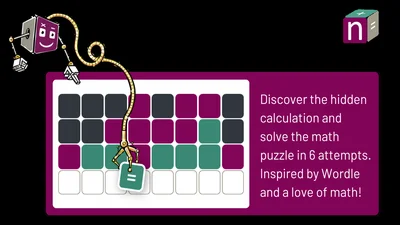
Numberle is a mathematical guessing game that applies the popular colour-coded feedback format to equations rather than words. Each puzzle presents a hidden equation using numbers and operators, and you must guess the complete equation within a limited number of attempts. The colour feedback tells you which numbers and operators are correct, misplaced, or absent, letting you deduce the hidden equation through mathematical reasoning.
The puzzle format requires thinking about both mathematical validity and positional logic simultaneously. Every guess must be a valid equation that actually works mathematically, which constrains your options far more than a word game where any letter combination is possible. This dual constraint of mathematical accuracy and positional deduction creates a uniquely challenging puzzle experience.
Understanding number relationships and operator properties gives you solving advantages. Multiplication and division produce specific result patterns that narrow possibilities quickly, while addition and subtraction are more flexible but less informative per guess. Strategic first guesses that test common operators and a range of digits provide the best foundation for subsequent deductions.
Playing Numberle online is a refreshing twist on the daily puzzle format that exercises mathematical thinking alongside logical deduction. The daily puzzle creates a shared challenge for maths enthusiasts to compare strategies and celebrate solutions. For players who find word games too dependent on vocabulary, Numberle offers a purely logical alternative that rewards reasoning ability.
How to Play Numberle Online
Enter a complete valid equation using the number pad and operator buttons provided. Your equation must be mathematically correct to be accepted as a guess. After submitting, each position receives colour feedback indicating whether that digit or operator is correct and in the right place, present but misplaced, or not in the equation at all.
Start with equations that use a variety of different digits and at least two different operators. A diverse first guess maximises the information you receive from the feedback, eliminating more possibilities than a guess that repeats digits or uses only one operator. Spread your initial guesses across the number range for broadest coverage.
Use the mathematical constraints to your advantage. If you know certain digits are present, calculate which equations are mathematically possible using those digits. The requirement for mathematical validity often means that knowing three or four elements of the equation leaves only one or two possible solutions, unlike word games where many options might remain.
Pay attention to the position feedback for operators as well as numbers. Knowing whether the equation uses addition, subtraction, multiplication, or division, and where those operators appear, dramatically narrows the solution space. The operator positions often reveal the equation's structure before the specific numbers are fully determined.