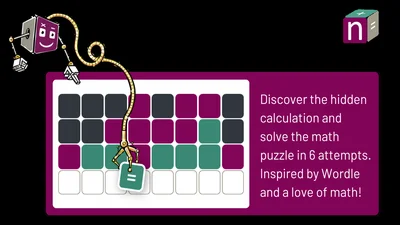
Numberle is the daily maths puzzle that asks one straightforward question: can you guess the hidden equation in six tries? Think Wordle, but replace every letter with a digit or arithmetic symbol. It’s accessible enough for anyone who made it through secondary school maths, deep enough to genuinely challenge you every day, and short enough to fit into any commute, break, or five minutes of procrastination.
Part of the wider wave of equation-guessing games that emerged alongside the Wordle explosion in early 2022, Numberle carves out its own identity with a clean, no-fuss interface and a daily puzzle format that feels consistent and fair. Every guess you make has to be a valid mathematical equation — no guessing random strings of numbers and hoping for the best. The game enforces real arithmetic, which keeps things honest and surprisingly educational.
The colour feedback works just like the original Wordle system. Green means you’ve placed a digit or symbol in exactly the right position. Yellow (or brown, depending on your colour settings) means it appears somewhere in the equation but in the wrong spot. Grey means it doesn’t appear in the solution at all. Six guesses is more than enough to crack most equations with sensible play — but the pressure of the streak counter has a way of making those six attempts feel very finite indeed.
There’s a satisfying mental shift that happens as you play Numberle regularly. You start approaching equations differently — thinking about which digit combinations produce clean results, which operators are most commonly used in short equations, and how to maximise the information gained from each guess. It’s the same kind of strategic thinking that makes Wordle so compelling, just wearing different clothes.
How To Play Numberle
Your goal is to guess the hidden mathematical equation in six attempts. Type any valid equation using the on-screen keypad — digits 0–9 and the operators + − × ÷ = are available. The equation must be mathematically correct to submit, so make sure both sides of the equals sign actually balance.
After each guess, the tiles change colour. Green means that digit or symbol is correct and in the right position. Yellow/brown means it’s part of the equation but positioned elsewhere. Grey means it doesn’t appear in the solution at all. Build on this information with each guess, systematically narrowing down the possibilities.
Start with an equation that uses a variety of common digits and operators to gather as much information as possible from your first guess. Avoid repeating grey characters in subsequent guesses. The equals sign always separates the calculation from its result, with the result on the right — keep that structure in mind as you build each attempt. Six guesses sounds like plenty until the streak pressure kicks in.