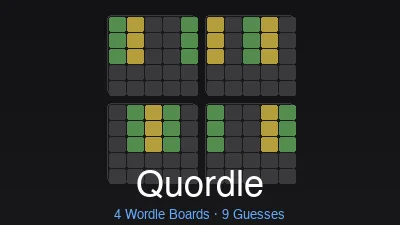
Duotrigordle is the most ambitious word puzzle variant, challenging you to solve thirty-two five-letter word puzzles simultaneously with just thirty-seven shared guesses. Every word you type applies to all thirty-two boards at once, creating an unprecedented exercise in vocabulary management and strategic deduction. The massive scale transforms a familiar puzzle format into something entirely new and extraordinarily challenging.
The interface displays all thirty-two boards in a grid, with colour feedback updating on every board after each guess. Tracking the state of thirty-two parallel puzzles requires exceptional cognitive organisation. Some boards solve quickly with common letters while others resist until very specific letter combinations are tested. Managing attention across this many simultaneous puzzles is a unique mental challenge.
The guess limit of thirty-seven for thirty-two puzzles means you have very little margin for wasted guesses. Strategic opening words that cover the most common letters are essential, as every guess must extract maximum information across all boards. The efficiency of your early guesses determines whether you have enough remaining attempts to handle the stubborn final boards.
Playing Duotrigordle online is the ultimate test for word puzzle enthusiasts who have mastered simpler variants. The sheer scale creates a satisfying marathon experience where solving all thirty-two boards feels like a major accomplishment. The daily puzzle format provides a consistent challenge that even the most dedicated word game players find genuinely difficult and rewarding.
How to Play Duotrigordle Online
Type a five-letter word and press enter to submit it to all thirty-two boards simultaneously. Each board processes the guess independently, showing green, yellow, and grey feedback for that specific word. Scroll through the board grid to check feedback on all thirty-two puzzles after each guess, or use the overview to spot which boards have the most progress.
Start with four or five carefully chosen words that together test all twenty-six letters of the alphabet or as close to it as possible. These opening words establish a foundation of information across all boards that makes subsequent targeted guessing possible. Common opening sequences test vowels first, then high-frequency consonants, covering the most statistical ground with each guess.
After your opening sequence, identify boards that are closest to being solved and target them with specific guesses. Solving boards early frees your mental capacity to focus on the remaining puzzles and confirms letters that might help other boards. The most efficient approach alternates between targeted solves and broad information-gathering guesses.
Keep track of your remaining guesses relative to unsolved boards. If you have twenty guesses left for fifteen unsolved boards, you are in reasonable shape. If that ratio tightens, switch to pure information-gathering words that test multiple unknown letters simultaneously rather than attempting to solve specific boards. Resource management across thirty-two puzzles is the skill that determines success or failure.